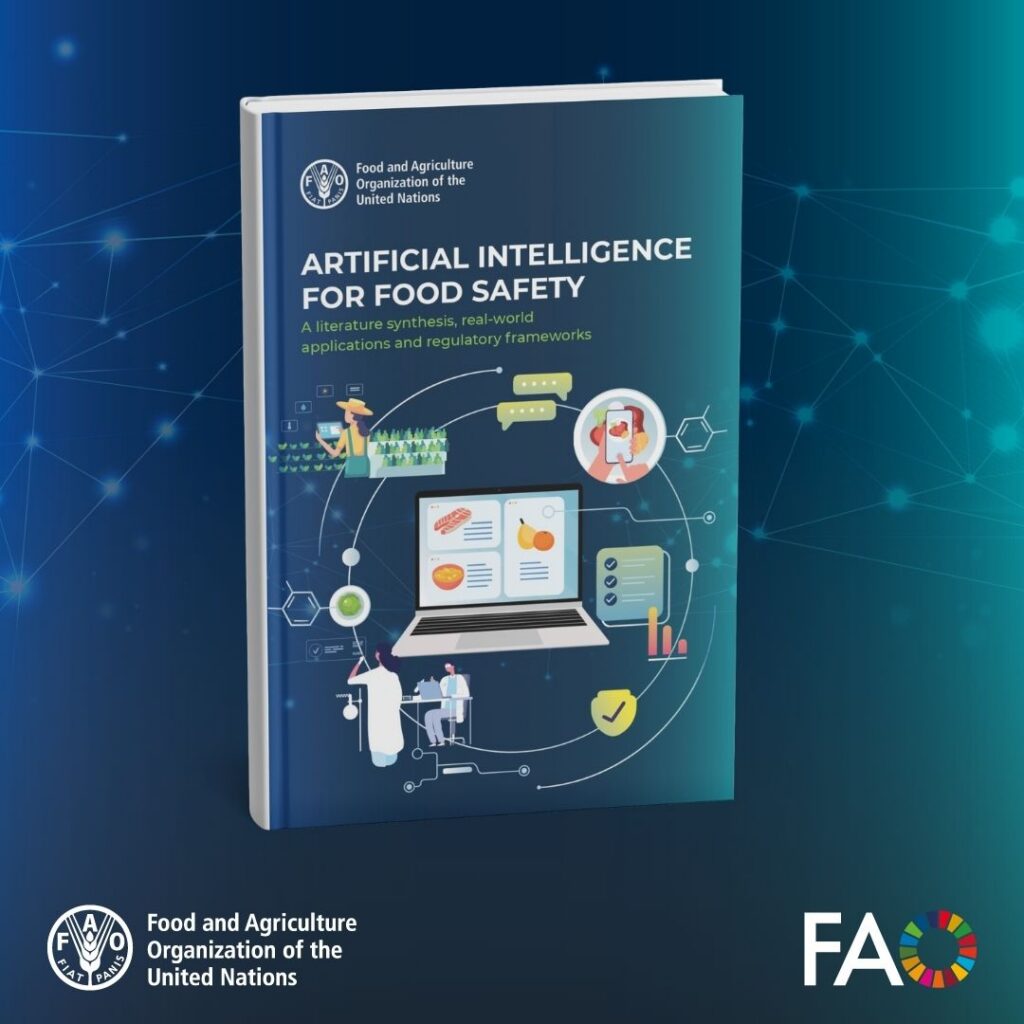
A new technical report by FAO and Wageningen Food Safety Research offers a global overview of artificial intelligence (AI) in food safety. Reviewing 141 recent scientific publications, it highlights practical applications of AI in laboratory testing, inspections, border controls, and risk communication, with examples from both high- and low-resource settings. The report also evaluates governance frameworks and stresses the need for high-quality datasets and improved AI literacy, especially in public sector agencies. Despite enthusiasm, the study notes data and capacity gaps in many food safety authorities, making responsible, well-managed AI adoption essential for risk-based prevention.

The publication draws from discussions at an FAO global seminar on November 6, 2024, which brought together 1,023 participants from 107 countries to share experiences and challenges using AI for food safety. As technology develops, FAO will continue to help countries adopt responsible AI solutions to reduce foodborne risks, optimize regulatory efforts, and strengthen food safety worldwide.
FAO launches publication on Food Safety Foresight

Foresight in food safety helps anticipate and manage emerging risks and opportunities over the medium to long term. A new FAO publication outlines best practices and guiding principles for policymakers, regulators, researchers, and industry professionals, showing how foresight techniques can strengthen preparedness across agrifood systems.

Amid rapid transformations driven by climate change, urbanization, global trade, and innovation, food safety challenges are becoming more complex. The FAO Food Safety Foresight Programme highlights the role of expert-led intelligence, digital tools, and multisectoral collaboration in identifying trends and supporting science-based risk assessment.

This approach empowers stakeholders to anticipate challenges, share knowledge, and inform proactive policy making, building more resilient and sustainable food systems worldwide.

A new joint publication by five key EU agenciesEFSA, EMA, EEA, ECHA, and ECDC—has been released, showcasing their ongoing scientific cooperation on One Health topics such as zoonoses, emerging risks, and antimicrobial resistance.

This paper, authored by Stefania Tampach, Ana Vidal, Ian Marnane, Wim De Coen, Ole Heuer, Carlos G. das Neves, Kerstin Gross-Helmert, Gorgias Garofalakis, and Stef Bronzwaer, analyzes the coordination tools outlined in Memoranda of Understanding and working arrangements between the agencies.
It highlights their collaborative efforts, including joint publications, and recommends exploring further mechanisms to enhance multi-sectoral cooperation and advance the implementation of the One Health strategy across the EU.

The Food and Agriculture Organisation of the United Nations (FAO) has published the report “FOOD SAFETY in personalized nutrition – A focus on food supplements and functional foods“, highlighting the evolving challenges in ensuring the safety of these products. Key aspects include ingredient safety (especially those without a history of consumption), interaction with medications, and the importance of appropriate dosage.
The report also compares global regulatory practices on classification, labelling, and oversight of supplements and functional foods. It offers strategic insights for strengthening food safety governance, particularly in low- and middle-income countries, promoting both innovation and consumer protection.

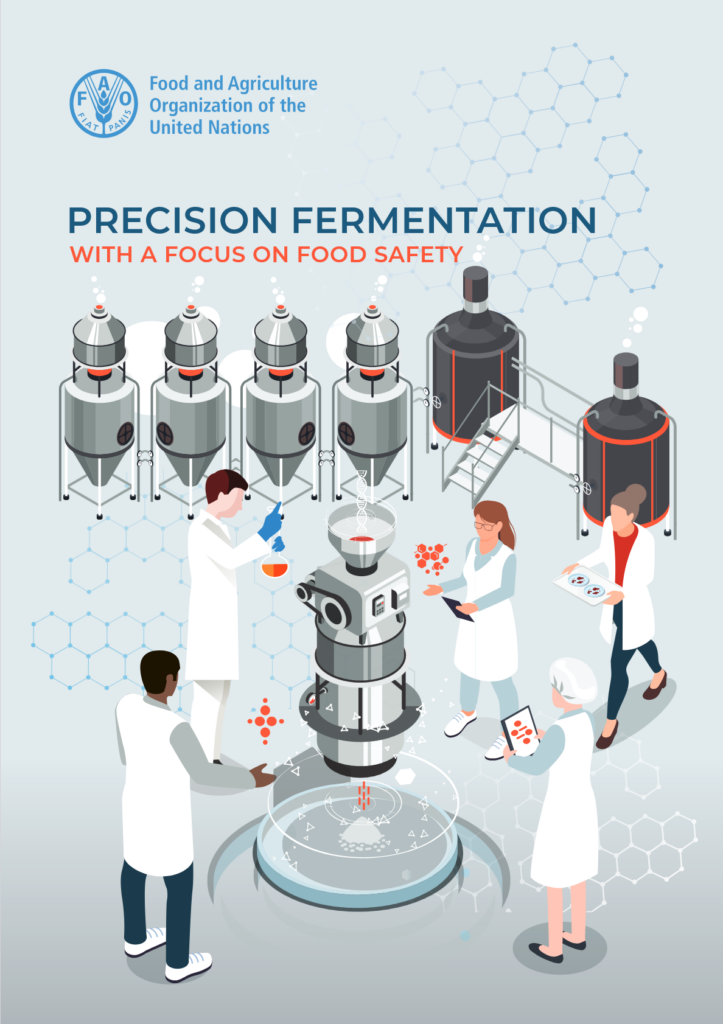
The Food and Agriculture Organisation of the United Nations (FAO) has published the report “Precision Fermentation – With a Focus on Food Safety“, which examines the emerging technology of precision fermentation and its implications for food safety.
Precision fermentation involves using specifically engineered microorganisms to produce targeted food ingredients such as proteins, lipids, and vitamins, often as sustainable alternatives to animal-derived products.
The report highlights the lack of a global definition for precision fermentation, complicating harmonised international regulations. It provides an in-depth analysis of the production process, potential food safety hazards-including allergenicity concerns-and compares regulatory frameworks across various countries. Through three detailed case studies and consultations with regulatory experts worldwide, the publication aims to guide policymakers and food safety authorities in establishing effective, adaptive regulatory approaches to ensure the safe introduction of precision-fermented foods globally.

New Eurobarometer Report

The latest Eurobarometer report, provides key insights into European citizens’ knowledge and attitudes towards science and technology. The survey explores public awareness, trust in scientific advancements, and perceptions of the benefits and risks of emerging technologies.

Key topics covered include:
Understanding of science and technology and sources of information
Impact on society, including climate change and innovation
Governance and public access to research results
Trust in scientists and their role in society

This report offers valuable data for policymakers, researchers, and industry leaders working to bridge the gap between science and society.

Read the full report here


A comprehensive resource for the EU Food and Drink Industry

The Data & Trends 2024 report by FoodDrinkEurope is now available. This essential resource offers detailed statistics and insights into the EU food and drink industry, highlighting its position as the largest manufacturing sector in the EU.

The report reveals that the industry employs 4.7 million people, generates a turnover of €1.2 trillion, and adds €250 billion in value. It also explores the cost of transitioning to more sustainable food systems, input costs, and future industry trends.

Additionally, the report provides a market outlook, showing that 65% of EU food and drink exports go to the Single Market, with exports outside the EU reaching €182 billion and a trade surplus of €80 billion. It includes a ranking of the top 50 food and drink companies worldwide.

This comprehensive report is an invaluable tool for professionals looking to understand the current landscape and future direction of the EU food and drink industry.

A new research insight has been published in the Food Control scientific journal: “Development of a digital Net-Map tool to analyse multi-stakeholder networks in risk analysis of emerging food safety issues.” The paper, co-authored by Niels van der Linden, Celine Meerpoel, Hanna Schebesta, and Pieternel Luning, experts from Wageningen University and the University of Gent, describes the application of the Net-Map tool in the context of the FoodSafety4EU project.
This innovative study introduces the Net-Map methodology, a tool designed to untangle the intricate relationships within multi-stakeholder networks. The findings reveal that food safety risk analysis networks are far more complex than the administrative frameworks established by legislation, providing a clear view of how theory aligns with real-world dynamics.

Key Findings:

  • The Net-Map tool effectively compares theoretical expectations with practical realities in risk analysis networks.
  • It helps scientists identify critical stakeholders for data collection.
  • Supports policymakers by highlighting areas for targeted interventions.
  • Encourages stakeholder awareness, fostering collaboration opportunities.

The digital tool serves as a game-changer for improving risk analysis approaches, offering practical benefits for all stakeholders involved in ensuring food safety.

Explore this publication to see how the Net-Map methodology can enhance collaboration and efficiency in food safety risk management. Download it below!

The white paper Food Supplements by LGC AXIO, an EU FOOD SAFETY PLATFORM member, explores regulatory gaps in the EU and US markets, emphasizing the need for improved standards, given the ease of access to these products in these regions.

The supplements market is growing rapidly, with a diverse range of active ingredients, degradation products, and contaminants requiring careful safety assessment. Recent scientific research supports the health benefits of dietary supplements—including vitamins, minerals, botanicals, and fatty acids—for aspects like athletic performance, cardiovascular health, weight management, and neurological support.
This trend has significantly fueled the supplements industry; however, concerns over quality and safety are rising.
Issues such as discrepancies between labelled and actual ingredient concentrations and the presence of contaminants highlight the need for rigorous oversight. Recent studies highlight significant regulatory gaps in the EU and US, stressing the need for improved methods to ensure reliable measurement of supplement quality and safety. Botanical supplements, in particular, raise concerns over potential side effects and drug interactions, as they lack the strict standards applied to pharmaceuticals. This variability underscores an opportunity for scientists and regulators to collaborate internationally to enhance public health. To meet the demands of informed consumers, more manufacturers are differentiating themselves through testing in accredited labs and participation in Proficiency Testing (PT) schemes, ensuring quality and compliance.

PT is critical in fostering transparency and accountability, helping quality brands distinguish themselves from those of lower quality. Insights from the LGC AXIO PT team reveal that quality markers and contaminants vary widely across products, presenting technical challenges for manufacturers striving to maintain high standards.

The white paper Unmasking Mycotoxins in Spices” by LGC AXIO, an EU FOOD SAFETY PLATFORM member, provides an in-depth analysis of mycotoxin contamination in spices and underscores its significance for public health and food safety.
With a particular focus on contaminants like aflatoxins and ochratoxin A, the report emphasizes the persistent risks mycotoxins pose to human health due to their toxicity and resilience, even through various processing stages. Mycotoxins, produced by mould species such as Aspergillus and Penicillium, are prevalent in various spices including chilli, nutmeg, and turmeric, often exceeding regulatory limits in the EU and international markets.

The report highlights proficiency testing (PT) as a key quality control measure to evaluate laboratory accuracy and reliability in detecting mycotoxins. Data from LGC AXIO PT schemes reveal that rapid testing methods, such as ELISA and LC-MS/MS, are essential for precise detection, though differences in method sensitivity persist. Additionally, the report considers the broader context of spice contamination beyond mycotoxins, addressing other hazards like pesticide residues, polycyclic aromatic hydrocarbons (PAHs), and illegal dyes.

The regulatory framework for mycotoxins, led by the EU’s Commission Regulation (EC) No 1881/2006, sets strict permissible limits for mycotoxins in spices, aligning with international standards such as the Codex Alimentarius. Yet, as the document indicates, ongoing challenges necessitate harmonized testing protocols and technological advancements to ensure food safety. This paper serves as a vital resource for experts, providing insights into the complexity of spice contamination, the need for global collaboration in standardizing testing, and the importance of enhancing laboratory capabilities to safeguard the spice supply chain