Innovation in Research and Education for the transition to sustainable food systems
ISEKIFOOD26 – the 8th International ISEKI-Food Conference 2026 will take place from June 1st to 3rd, 2026, and will be hosted by the University of Algarve in Faro, the heart of the southern coast of Portugal. This year’s conference, themed “Innovation in Research and Education for the Transition to Sustainable Food Systems,” will be a platform for global experts to discuss pioneering advancements in the agri-food sector.
This edition will provide opportunities for oral and poster presentations across three major topics, aiming to foster discussions and collaborations toward more sustainable food systems:
1. Education and training for sustainable and innovative food systems 2. Research for sustainable and innovative food systems 3. Responsible food production and consumption
Key Dates to Remember:
Abstract Submission Deadline: 8 February 2026
Notification of Abstract Acceptance: 20 Mar 2026
Early Bird Registration Closing: 13 April 2026 (payment to be completed by May 1)
The 2025 EU Food Safety Forum – held on December 2-3, 2025, at the CNR headquarters in Rome – highlighted the Forum’s role as a collaborative space where scientists, policymakers, industry and citizens jointly address food safety, sustainability and geopolitical challenges, and set priorities for the 2026 edition.
Key messages Participants stressed the need for a united European scientific community that also engages society at large, underlining responsible participation, leadership and long‑term policy vision as crucial to protect food safety in a context of geopolitical instability, funding cuts and big transitions. Speakers pointed to skills gaps linked to automation and called for renewed investment in training new talent in food safety research.
The discussions emphasised that innovation must move from isolated projects to true ecosystems based on co‑creation, where research, companies, authorities and consumers work together rather than in silos. Building trustful bridges with developing countries was identified also as essential to strengthen global food security and safety.
Science-Policy-Society Synergy
The Science-Policy-Society Synergy session, introduced by CNR representatives – Silvano Fares, Nicola Fantini, Antonio Moretti and Veronica Lattanzio – opened the Forum by underscoring the need for a close and structured interaction between scientific evidence, policymaking and societal needs in shaping the future of food safety in Europe. The session highlighted a comprehensive, multi‑stakeholder approach aimed at ensuring that food safety strategies are fully aligned with public health priorities and with the evolving expectations of consumers. Following an expression of gratitude to the institutional representatives for their valuable contributions and their willingness to cooperate with the EU FOOD SAFETY PLATFORM, the floor was given to key contributors: Stef Bronzwaer from EFSA, Angelo Riccaboni from PRIMA Foundation, Serena Borgna from APRE, Giovanni Leonardi from the Italian Ministry of Health,and Magdalena Zatorskafrom the University of Warsaw. Their interventions underlined the importance of coordinated action among competent authorities, the scientific community and society at large to strengthen trust and to prepare food safety systems to address emerging challenges effectively and boost competitiveness in the bioeconomy framework.
Updating the SRIA in the Bioeconomy framework: a multi-stakeholder vision
This session convened a broad range of actors to jointly reflect on the future direction of food safety research and innovation. Building on previous co‑creation efforts, it explored how emerging priorities in the bioeconomy can be integrated into the Strategic Research and Innovation Agenda (SRIA) for food safety.
This critical discussion showcased how science, policy, and innovation converge to define priorities for the Strategic Research and Innovation Agenda (SRIA).
Future-Oriented Co-Creation
The session “Updating the SRIA in the Bioeconomy Framework: a Multi‑Stakeholder Vision” convened a broad range of actors to jointly reflect on the future direction of food safety research and innovation. Building on previous co‑creation efforts – including input from the FS4EU project, the EU FOOD SAFETY FORUM 2023 and 2024 – it explored how emerging priorities in the bioeconomy can be integrated into the Strategic Research and Innovation Agenda (SRIA) for food safety. EU Food Safety Platform experts Nastasia Belc (IBA Bucharest) and Pieternel Luning (WUR) led the session, focusing on updating theSRIA to address emerging challenges. Participants – working in 4 sub-groups – discussed how collaborative initiatives and advanced research are already contributing to the transformation of European food systems, preparing them to respond more effectively to upcoming challenges in their transition towards a bioeconomy model and greater competitiveness.
Cooperation space
The EU FOOD SAFETY PLATFORM served as a catalyst for future cooperation, outlining a broad framework that connects research infrastructures, networks and innovation actors. Presentations from European research and international infrastructures showcased the resources and services offered by projects such as FHERITALE and Up-rise, alongside concrete experiences from companies including ENCO s.r.l. with SEEDS – Saining Economies and Enhancing Dynamic Structures, and nextProtein SA, as well as key networks such as FoSSNet: Pan-European Food Systems Science Network, CERERE – PRIMA Agrifood cluster, and Food Safety and Risk journal – BMC, part of Springer Nature. The session also highlighted methodological tools for understanding and visualising connections within these communities, such as Net-Map analysis. The session was conducted in an engaging format by Monika Tomaniova (UCT PRAGUE) and Mari Eskola (MEDFILES), who facilitated exchanges between infrastructure representatives, companies and scientific networks.
6 selected Young researchers took centre stage in the “Youths in action for the Future of Food Safety in the EU” session, presenting their poster pitches on food safety research and innovation. This dedicated space confirmed the Forum’s commitment to empowering the next generation of food safety experts and integrating their perspectives into the broader European agenda.
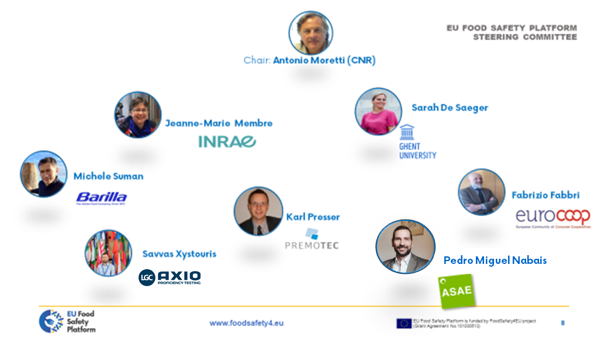
The Closing Session of the 2025 EU Food Safety Forum was conducted by Michele Suman excellently wrapped up in the closing session, together with the Platform Steering Committee members Antonio Moretti, Karl Presser, Jeanne-Marie Membré, Savvas Xystouris, Sarah De Saeger, and Coordinator Veronica Lattanzio, Nunzia Cito. The panel confirmed the Forum as a collaborative space where scientists, policymakers, industry and citizens jointly address food safety, sustainability and geopolitical challenges. It underscored the EU Food Safety Platform’s commitment to fostering innovation and sustainability through collaborative efforts, while setting priorities for the 2026 edition.
As participants return to their respective fields, the lessons learned and partnerships formed in Rome are expected to drive impactful changes in food safety systems across Europe. The continued engagement of all stakeholders will be crucial in advancing the platform’s goals and ensuring a safer food future for all.
Thank you for all for the participation!
The Forum is powered byour Platform members
A Special Issue of the Food Safety and Risk Journal will showcase selected breakthroughs and the outomes of our multi-actor event!
With the increasing complexity of global food systems, emerging risks in food safety demand more sophisticated approaches. Artificial Intelligence (AI) is transforming the field, and, although still emerging, is set to play a critical role in the EU’s food safety systems. The EU’s FoodSafety4EU and HOLiFOOD projects highlight AI’s potential in predictive risk analysis, digital platform co-design, and fostering a culture of data sharing among stakeholders. By exploring technical, legal, educational barriers and enabling factors, as well as by piloting co-developed solutions, these projects are paving the way for a safer, more resilient food supply chain.
FoodSafety4EU and HOLiFOOD employ a “living lab” approach, where AI capabilities are co-developed across various multi-stakeholder participatory workshops. This collaborative model connects and engages with experts from diverse sectors, advancing risk assessment by incorporating cross-disciplinary insights and fostering innovations in AI and machine learning (ML).
The FoodSafety4EU Strategic Research and Innovation Agenda (SRIA), as a result of one ofthese living labs, emphasizes AI’s transformative potential for real-time and anticipatory risk management. It envisages priority research needs to provide food business operators (FBOs) and authorities with the tools necessary for transparent, adaptive food safety protocols.
The ongoing living labs in the HOLiFOOD project are driving a multi-actor co-design approach on AI-related food safety topics, namely i) AI-driven emerging risk identification, ii) holistic risk assessment and acceptance and iii) AI-driven digital platform codesign. Through AI-driven data collection and advanced modelling, these living labs target challenges such as environmental contaminants, microbiological hazards, and climate-driven shifts in foodborne risks.
Future Directions: enablers and challenges in trusted AI development
AI’s role is as effective as the trust it garners from stakeholders. Critical enablers include harmonized legislation for data sharing, user-friendly interfaces, and infrastructure that ensures data accessibility. The EU is urged to streamline policies that facilitate safe data flows while respecting GDPR and data protection laws.
As we move towards integrating AI into everyday food safety practices, ongoing research emphasizes priority risk areas, including pesticide contamination, microbial hazards, and environmental contaminants. Recognizing the nuances of these risks, especially in light of climate change, will require both robust AI-driven data models and a balanced approach to communicating risks to the public and industry players alike.
📅 Date: November 13, 2024 🌐 Format: Online via Zoom
This event will bring together leading researchers, experts, including the EU FOOD SAFETY PLATFORM Coordinator, Veronica Lattanzio, and Management Board members to address the pressing issue of contaminants in the food supply chain—a pivotal challenge for food safety, public health, and sustainable development in Europe.
🔬 The program will feature:
Scientific presentations on recent advances in contaminant identification and reduction
Case studies and innovative research methodologies
Discussions on collaborative initiatives and future research opportunities
Interactive Q&A sessions with field specialists
We encourage researchers from all disciplines involved in food safety to join us for knowledge exchange and cross-sector collaboration.
Let’s advance together toward safer and more sustainable food systems!
The International FoodTec Conference – Shaping the Future of Sustainable Food Ecosystems – will be held from the 27th to 29th of October 2025. The event convenes together leading experts in advanced research, innovative food solutions, prominent stakeholders from the food industry, and policymakers focused on strategic planning and funding for the sector. The Conference is organized under the scope of the European Net4Food Project – Research and Innovation Network for the Food Sector in the Cross-Border Region – and funded by Interreg POCTEP. Veronica Lattanzio, EU FOOD SAFETY PLATFORM Coordinator, will be key note speaker in the Session “Innovation, Technology and FoodSecurity in a Changing Global Landscape“. In her speech, Veronica Lattanzio highlighted the need for multi-stakeholder collaboration and innovation to ensure food safety across dynamic global food systems, addressing challenges like climate change, resource depletion, technological advancement, and evolving consumer expectations. She also stressed the importance of evidence-based decision-making, digital transformation, biotechnology, and data-driven approaches for future-proofing food safety systems.
Theme:Hand in Hand for Better Foods and a Better Future
The FAO Science and Innovation Forum (SIF) 2025 will take place from 13 to 17 October at FAO Headquarters in Rome, as part of the World Food Forum. This global event brings together scientists, innovators, policymakers, and stakeholders to explore new paradigms of cooperation and innovation for sustainable agrifood systems.
The Forum will feature high-level plenaries, immersive exhibitions, and interactive sessions focused on building resilient, inclusive, and equitable food systems. Key themes include integrated science, trust-building, inclusive cooperation, and science-policy-society interfaces.
EU FOOD SAFETY PLATFORM at SIF 2025
The EU FOOD SAFETY PLATFORM will be among the exhibitors at SIF 2025, presenting its role as a science-policy-society interface that connects over 80 institutions across Europe.
The joint exhibition with CNR ISPA will highlight:
A Portable Oxygen-Sensor Biosensing Platform for rapid, field-ready microbial detection in food.
A digital showcase of the EU FOOD SAFETY PLATFORM, including interactive tools, infographics, and co-creation spaces.
This contribution reflects the platform’s commitment to participatory governance, innovation, and collaboration in food safety—aligned with the Forum’s mission to accelerate agrifood systems transformation. 🔗 More info at the SIF Exhibition dedicated page
On Monday, 6 October 2025, Rome will host the international workshop “The transition towards a safe and sustainable food system in a changing world: a One Health challenge”, organized by the National Institute of Health – Istituto Superiore di Sanità (ISS) in collaboration with the Experimental Zooprophylactic Institute of the Veneto- Istituto Zooprofilattico Sperimentale delle Venezie (IZSVe).
Faced with profound changes in the global scenario, food production systems must urgently address increasingly complex challenges: climate change, the globalisation of the food supply chain, population growth, mass migration and changing eating habits. All these factors make it necessary to transition to a food system that is environmentally, socially and economically sustainable.
Food, climate, health and the economy will therefore be the focus of the meeting, which will feature experts from leading international health agencies such as FAO, EFSA, Wageningen University (Netherlands), Catalan Water Partnership (Spain), as well as speakers from the organising bodies. They will take stock of the current situation and identify the scientific knowledge and needs that will guide this transition in the medium to long term.
The main objective of the day is to identify emerging trends and new health hazards, analysing the possible implications for health risk assessments. The workshop aims to explore the role of the circular economy in achieving food sustainability goals and to identify innovations and sentinel events that can help anticipate the need for new health risk management strategies.
A round table will follow, with delegates from FAO, WHO, and WOAH joining other speakers. The discussion will focus on how to evaluate the factors influencing sustainability, the necessary support from policymakers and laboratories to make the new framework operational, and ways to verify its effectiveness. Finally, the group will also reflect on social challenges and the active involvement of citizens, with the goal of building future food systems that are truly sustainable, equitable, and safe, following an integrated One Health approach.
Details
The workshop will be held in English (without translation) at the Pocchiari Hall at the ISS headquarters in Rome, Viale Regina Elena 299. Attendance is free, with 200 available spots on a first-come, first-served basis. A certificate of participation will be issued upon request. The event is particularly suitable for researchers, public health professionals, policymakers, journalists, and other stakeholders.
The 6th Edition of ICFC focusing on “Challenges on Emerging Contaminants and Planetary Health” will be held, in person, on the 25th to 26thSeptember 2025 at the auditorium of the Museu de Eletricidade Casa da Luz (www.museucasadaluz.pt) in Funchal, Madeira, Portugal. This multidisciplinary conference provides a forum for both internationally established and young researchers to exchange advanced knowledge on Food Contaminants and Human Health. The conference will include lectures given by world-renowned scholars, in addition to oral and poster presentations.
Key topics include: 🔹 The role of predictive modelling in tackling climate change, food integrity, and One Health challenges 🔹 Harnessing big data, AI, and machine learning for risk assessment and supply chain transparency 🔹 Strengthening collaboration between scientists, industry, and policymakers to build a resilient food system
Congress Dates: September 25-26, 2025 Conference website
The upcoming International Conference on Predictive Modelling in Food and Food Risk Assessment will be held at Technopolis City of Athens, Greece. Predictive modelling has revolutionized food safety and quality, enabling risk-based decisions, enhanced transparency, and smarter interventions across the food supply chain. This conference will explore how cutting-edge technologies can shape the future of food safety and sustainability in the new era of AI, data science, and digital transformation.
Key topics include: 🔹 The role of predictive modelling in tackling climate change, food integrity, and One Health challenges 🔹 Harnessing big data, AI, and machine learning for risk assessment and supply chain transparency 🔹 Strengthening collaboration between scientists, industry, and policymakers to build a resilient food system
Abstract Submission Deadline: February 28, 2025 Congress Dates: September 1-3, 2025 Conference website
This one-day event is designed to inspire and empower early career scientists by providing a platform to share innovative research, explore emerging challenges, and connect with leading voices in food safety, nutrition, and sustainability.
The event includes the following sessions:
Hidden Threats: Emerging Contaminants in Food and the Environment
The Future of Food Safety: New Approach Methodologies in Risk Assessment
Safe and Sustainable: Navigating the Risks of Alternative Proteins
Unseen Risks—Volatile Allergens and Toxins in Aromas and Flavorings
Including a Live Case Study: From Risk Assessment to Management
The organizing committee will review the submitted abstracts, and selected authors will be invited to present their work in 10-minute talks following the keynote speakers. Early Career Scientists are also eligible for one of the two awards: best oral or poster presentation. To be eligible for the video awards, submit a video related to NAMs according to the video guidelines.